A servant in the small village of Dothan rose before the sun and stepped outside to draw water for his household. Instead, he walked into a different world than the one he had gone to sleep in.
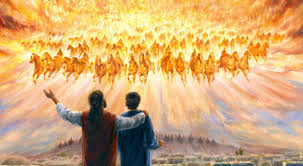
The hills around the city were no longer hills. They were horses. They were chariots. They were ranks of soldiers standing shoulder to shoulder in the gray light, more of them than he could count, surrounding the city on every side.
An army had wrapped itself around the walls in the dark while everyone slept, and there was no gate that was not watched, and no road that was not closed, and nowhere to run.
He feared, with what seemed like perfect certainty, that he was going to die. So was Elisha. So was everyone in Dothan. The Syrians had not come to negotiate. They had not come to take prisoners. They had come for the prophet, who was foiling all of their plans, and they had brought enough men to take him a hundred times over. By the time the sun was fully up, their home would be ash.
He ran back inside, searched for Elisha, and asked:
Alas, my master. How shall we do?
Elisha looked at this terrified young man and said something that did not make any sense:
Fear not: for they that be with us are more than they that be with them.
And then Elisha prayed. Not for rescue. Not for an army. Not for escape.
He prayed that his servant’s eyes would be opened.
The story of Elisha and the Syrian army at Dothan in 2 Kings 6 has resonated with me ever since I heard it taught by Brother Robert McIntosh in Santa Barbara as a missionary.
The danger the Syrian army posed was real. The servant was not foolish for being afraid of it. The danger was overwhelming, but it was not the whole truth.
The whole truth was that the mountain was also full of horses and chariots of fire, and they had been there the entire time. The servant did not see them because his eyes had not yet been opened. The unseen help was not waiting to arrive. It had already arrived. It was already there.
Elisha knew the hosts of heaven were there, and I still get emotional when I think about the moment the servant’s eyes were opened. His new vision showed something unthinkable: a host of heaven there to help them when they needed it most. Can you imagine his shock, the relief, his joy?
On its surface, this story seems impossible. How could an invisible host of heaven save this village and attack and chase away the Syrian army? This same impossibility of relief, of salvation, of comfort has come to many of us or those we love, when we are in situations where we feel completely alone and overwhelmed, as if nothing we could do would alter the inevitability of our fate. What is also true is that there is a host of heaven, sometimes unseen, that is already there to bring us relief.
Sometimes it is Hard to See
In the years after my mission, I was in an unhealthy relationship. It pulled me away from my family. It pulled me away from my friends. It pulled me away from God. I knew it was wrong while it was happening. I was the one mostly to blame, but I could not seem to stop it from happening anyway.
When the Lord finally intervened and I broke it off, the relief I had hoped for did not come. What came instead was the loneliest stretch of my life.
I felt too guilty to go to church. I felt too guilty to pray. I was sure my family was disappointed in me, and my friends had moved on without me. I did not really know what to do with my days. I was lost in a way I had not been lost before, and I was afraid.
What I did not know — what I could not have known sitting in my apartment by myself — was that the host was already there.
One day, my friend Parker called me and said we should work together.
Just like that. A simple invitation, and I had something to do tomorrow.
Then Jed told me I could come live with him in Provo while we figured it out.
Just like that, I had somewhere to go.
Within a few months, a whole group of my friends and I were moving to Las Vegas together, starting an adventure that would change my life.
None of them gave a speech. None of them sat me down to fix me. They just invited me.
My family hadn’t left me either; they kept showing up the entire time. They kept telling me, in a hundred small ways, that I had not been written off and that there was still a place for me with them. They showed me I was loved.
It took me a long time to recognize what I had. Those phone calls, those invitations, all the adventures and challenges together — that was the host. It had been there the whole time. My family had not actually moved away from me. My friends had not actually forgotten me. God had not actually given up on me. I just could not see any of it from inside my own fear.
The miracle was not that help arrived when I called for it. The miracle was that the help had already been there, waiting for me to open my eyes long enough to let it in.
Initially, as a missionary, I came to love the story of Dothan and viewed it as a big moment reserved for the most dire circumstances – reserved for prophets in besieged cities. Later, as my life has played out, I realize it is much more a story about moments that matter deeply to each of us, when we realize there is a “host of heaven” there to help us all along.
Have you ever noticed that when you are at your lowest, and someone gives you a hug or a smile or shows up at your door for no reason, the comfort that comes is somehow stronger than the gesture should have been able to carry? Have you been there for someone who was grieving and felt your own love for them grow into something larger? Have you ever been with a group of people in a hard moment and felt that, with them, you all became braver, kinder, and steadier than any of you could have been alone?
I do not think that is an accident. I think that was one of the lessons Elisha was teaching the servant.
Goodness, kindness, faith, and love are amplified when they connect us. They are amplified because they are not just ours. They are joined to something larger. The unseen army on the mountain not only delivers cities. It moves through ordinary people trying to love each other, and it makes their love weigh more than it should.
This is one of the reasons the Lord asks us to bear one another’s burdens. Not just because the burden gets lighter when more people carry it, though it does. But because something happens in the carrying that brings the host closer. We do not see chariots of fire. But we feel the love magnified into a ever burning warmth. We feel the strength that did not come from us that empowers us to overcome.
Most of us will never have a Dothan moment, where the curtain pulls back, and we see the cavalry of heaven on a hillside. But almost all of us have had a moment of unexpected comfort, of unexpected courage, of love that was bigger than the person delivering it. Those are not lesser experiences, and sometimes seeing the host that is in your life, when life is too hard to handle, can be as difficult as the servant seeing the hosts of heaven on the hillside.
A Heavenly Host
Almost every culture in human history has believed, in one form or another, that those who loved us in life do not stop loving us when they leave it. That our ancestors watch over us and are closer than it seems. We believe this too. We believe in angels, and we believe that many of those angels are family — that the veil between this world and the next is thin. Many of us have felt this even when we could not explain it.
Think of what happens to an athlete who loses a loved one during a season. Watch the way they play their next games with a name written on their wrist, or a number raised to the sky after they score. Something is unlocked in them. They are not playing for themselves anymore. They are playing for someone, and somehow that someone is still with them, and the performance seems to rise above their capabilities. We see it again and again and recognize it instantly because we have felt some version of it ourselves.
When I remember the strength of the people who came before me — the grandparents who carried harder lives than I have ever had, the ancestors I know only through a few stories — I do not just feel sentimental. I feel steadier. Remembering how they endured gives me energy to endure. Knowing that they loved me and that they have not stopped gives me a reason to keep going that is bigger than my own willpower. That is not just memory. That is power. It is part of the host.
Sometimes we think of heaven in the abstract, billions of nameless, faceless beings, but when we remember that the faces and names are real and that those people love us, then there becomes a power in thinking about them and feeling their presence in our lives. There are truly more that be with us than we realize.
Elisha
I love Elisha. If you haven’t studied much about Elisha, I suggest you spend some time learning about him and all the crazy things he did as a prophet. In particular, his role in Dothan is something we often don’t think enough about. Elisha did not just know that the hosts of heaven were already there; he specifically prayed for someone else to see them, too.
Being a mentor, a leader, or sometimes even a friend to people who are afraid and telling them — sometimes against the available evidence — that there is a host of people who love and support them is a critical role that we often take for granted. In fact, the unfortunate reality is that many of us, when faced with someone in a tough situation, react first with judgment about how they got into it, or with trepidation that getting involved will only bring the problem into our own lives.
Elisha’s example is to be the one who helps someone else see what they cannot – love and support are there right now.
About a year into my mission, I was transferred to Santa Barbara. It was the most sought-after assignment in the mission — a beautiful place, good people, and teaching people our own age in the University ward. A few months in, our district was struggling with the actual work we were there to do. We had not had many baptisms. The work was not moving as well as it could have been, and even though we all liked each other, it felt a bit disjointed and underwhelming.
Our mission president was President Clarke. He came to Santa Barbara for a zone conference, and instead of giving us a normal training, he sat us down and told us the truth. He said the work was not moving because we were not fully united. He said God could not pour out the blessings He wanted to pour out on this area while we were not loving each other, not praying for each other, not really invested in each other’s success.
And then he did something I have never forgotten. He had us go around the room, missionary by missionary, and pray out loud for each other by name. Not pray with each other. Pray for each other. For each missionary’s investigators. For each companionship’s struggles. For the people we did not yet know who were waiting for someone to find them.
I do not know how to describe what happened in that room except to say that something opened. We were not the same district when we walked out as we had been when we walked in. We started praying for each other every day. We started calling each other. When a companionship found someone, the whole district prayed. When someone was struggling, the other missionaries showed up to help.
Over the next three months, we baptized more than thirteen people. We brought another dozen back to church. The miracle was not the numbers, although the numbers were a miracle. The miracle was watching as our eyes were opened to the power of being part of the host of heaven. Helping people as proxies for the Savior, as His representatives, changed us and blessed other people’s lives – even more so because we did it together.
President Clarke was Elisha in that room. He saw something we could not see, and he prayed for our eyes to be opened — not by waiting for God to do it, but by gathering us into a host of our own. He did not pray for the work to move. He prayed for us to become the kind of people the work could move through.
And when we do that for someone else — when we are the one who calls, who shows up at the door, who organizes the fast, who tells the truth in a room that needs to hear it — we become the chariots of fire on someone else’s mountain.
Things Are Different Now
In today’s age, we do not face the Syrian army. We do not face giants with spears.
But we face something just as dangerous. The voices around us are louder than they have ever been in human history. The news tells us the world is collapsing. Social media tells us we are not enough or that we should be afraid of everyone who is different from us. Thousands of comparisons tells us we are behind. Outrage heightens our emotions. Despair tells us nothing matters.
These voices are real. The servant was not foolish for seeing the army on the hills, and we are not foolish for hearing the noise of our age.
I do not want my children to grow up afraid of the world we live in today. I want them to grow up able to see it correctly. And I want them to grow up willing to help others see it, too.
I want them to know that they are never alone. They have a host of family, a host of friends, a host of fellow disciples, and a host of heaven, which includes those who loved them and went on ahead. The host is real. The host is theirs. They just have to learn to see it.
I want them to know that when they feel surrounded and overwhelmed, the help has already arrived and is just waiting for their eyes to open. I want them to know that the people who loved them have not stopped loving them, that the God who called them has not stopped calling them, and that the Savior who walked through His own valley is walking with them through whatever valleys they are facing.
I want them to join the host. To show up for the people they love, and for the people they have not met yet, even when they cannot tell whether it is making a difference. Because every time they do, someone else’s eyes get a little closer to opening.
Fear not: for they that be with us are more than they that be with them.
It was true on a mountain near Dothan three thousand years ago. It was true in my lonely apartment. It was true in a chapel in Santa Barbara.
It will always be true.
ADDITIONAL RESOURCES
Podcasts
- Faith Matters Podcast: Encouraging faithful inquiry amid complexity.
- Comeback Podcast: Sharing Stories of those who left the church and came back.
- Unshaken with Jared Halverson: In-depth historical and doctrinal studies for those wrestling with tough questions.
- Leading Saints: Insights into modern leadership and discipleship, often addressing nuanced challenges.
Books
- Saints: The Story of the Church of Jesus Christ in the Latter Days (Vols. 1–2): Thorough Church history, incorporating modern research.
- Planted by Patrick Q. Mason: A compassionate approach to faith challenges.
- The Crucible of Doubt by Terryl and Fiona Givens: Thoughtful exploration of faith reconstruction.
- Joseph Smith: Rough Stone Rolling by Richard Lyman Bushman: A deeply researched biography reflecting Joseph’s certainty and complexity.
- Making Sense of the Doctrine and Covenants by Steven C. Harper: A summary of the history and context for each section of the Doctrine and Covenants.
Blogs and Articles
- Gospel Essays: Accessible discussions suited for individual and group study.
- Faith Matters: Engages contemporary faith topics with candor.


