In many respects, Moses may be the most well-known religious figure in the world besides Jesus.
Most of us know his story: He grew up in Pharaoh’s household, raised Egyptian, educated Egyptian, by every visible measure, he was a son of the empire that had enslaved the Israelites. And yet when he saw an Egyptian taskmaster beating a Hebrew slave, something cracked open in him that all the privilege of the palace couldn’t contain. He killed the man and fled — not as a revolutionary, but as a fugitive. He ended up in the wilderness of Midian, herding sheep, apparently going nowhere.
Sometimes I feel like we think, after watching The Prince of Egypt or The Ten Commandments, that Moses returned to Egypt just a few years later, but it was forty years before he did.
Forty years had passed. That is almost as many years as I have been alive.
I think about that a lot. Forty years went by before the burning bush, plagues, pillars of fire, or the Ten Commandments. Forty years of wandering before Moses understood what he was actually being prepared for. And even then, when God spoke to him out of the fire, Moses wasn’t convinced. He said, essentially, I am not the right person for this.
Many insights can be found in God’s selection of a shepherd with a criminal record and a speech impediment, but for this essay, I see Moses as a pattern for Israel, and for us.
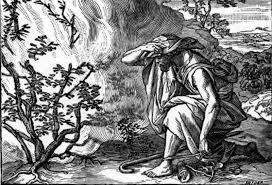
Moses grew up in the palace’s prosperity, but then lost everything. Then for years he wandered, probably wondering why his life had become what it was. Then he found himself standing barefoot on holy ground, with God calling him to something greater — not because he was educated, powerful, or even successful, but because he’d been emptied of the things that would have gotten in the way.
Moses’ own journey is a symbol for the entire story of Exodus. But it is also, from a certain point of view, our story too.
From Joseph to Moses: Forgetting Who We Are
The distance between the end of Genesis and the beginning of Exodus is only a few pages. In historical terms, it spans roughly 400 years — about the same distance separating us from the Pilgrims.
When Joseph’s brothers sold him into slavery, God was already working inside that betrayal for the future of Israel. Joseph rose to Pharaoh’s second-in-command, interpreted the dreams that predicted seven years of abundance and seven years of famine, and organized Egypt so effectively that when the famine struck, people came from across the ancient Near East to buy grain. Including his own brothers.
Their reunion is one of the most emotional scenes in Genesis. Jacob and his sons — seventy people in all — settled in Goshen in northern Egypt, and for a time, they prospered under Pharaoh’s favor.
That prosperity was real. And it was likely what eventually became their downfall.
John H. Walton, writing about the cultural world of these narratives, emphasizes that identity in the ancient Near East was always communal and always tied to story. You knew who you were because you knew whose you were — whose son, whose tribe, whose covenant. The covenant wasn’t just a religious arrangement. It was the organizing principle of everything: how they understood their past, their purpose, and their God.
Prosperity quietly erodes the need for the covenant. Not all at once, and not through any dramatic act of rebellion. It happens the way Hemingway described bankruptcy — gradually, then suddenly. When life is comfortable, the urgency of the covenant fades. The stories still get told, but they lose their weight. The rituals continue, but they become a habit rather than a memory. The God who carried your ancestors through famine and exile starts to feel less essential when the flocks are healthy, and the children are fed. Identity doesn’t disappear — it just slowly stops being the thing you organize your life around.
And when covenant identity fades, something fills the space. In Israel’s case, it was Egypt — its culture, its gods, its definitions of status and security, and what a good life looked like. Assimilation is rarely a conscious choice. It is the natural drift of a people who have stopped telling themselves who they are.
The book of Exodus opens with a chilling transition that seems like a simple statement, but means much more: “Now a new king arose over Egypt, who did not know Joseph.” (Exodus 1:8). That sentence is doing more than reporting a change in administration. I believe it is likely that Israel started losing its covenant identity after a few generations of prosperity. Then, a Pharaoh who felt no obligation to the God of Abraham — or to the man who had saved his nation — looked at this large, prosperous, no-longer-distinctly-covenant people living in Goshen, and saw a labor force to subjugate.
This is the pattern that the Book of Mormon traces again and again, and that I believe is one of the most honest warnings in all of scripture: broken covenants leave us vulnerable. When we stop organizing our lives around our relationship with God — when comfort replaces covenant as the center of gravity — we don’t simply drift into a kind of pleasant spiritual neutrality. We drift toward whatever power is willing to define us instead. And that power rarely has our best interests at heart; in the case of Israel, it was the culture and power of Egypt.
If the patterns we see in other scriptures are reliable, then the Israelites didn’t choose bondage. But they had, generation by generation, chosen comfort over covenant. And bondage was where that road eventually led.
As Latter-day Saints, we understand covenant identity as something that must be actively maintained across generations — through ordinances, Christlike love, family history and journal writing, and service-oriented living. Comfort is not necessarily the enemy of faith, but if not recognized as an obstacle, it does become a quiet, patient, almost invisible enemy to our covenant relationship with God — one generation at a time.
The Cage We Build for Ourselves
I have spent a good portion of my adult life building things—an incredible family, a business, partnerships, cool projects, friendships, and a life that, by most external measures, represents success. The vast majority of these efforts were a struggle; they could have failed at any moment, and I had to put my faith in God to help. The fear of failure was a driving force in my life, and I needed God’s help to succeed; thankfully, He was always there.
Interestingly, a few years ago, I noticed something I didn’t expect. I began to feel anxiety and fear that I hadn’t felt before. Not the fear of failure — that has always motivated me forward. This was the fear of losing what I had built. And that fear impacted me in ways I never anticipated. I began to fear death, or small problems turning into big ones at work, and I began to worry that I was screwing up my kids. This kind of fear was a bit paralyzing for me. I am a mover and goer, so feeling those effects was very difficult for me.
As I’ve thought about why the fear of loss was so hard for me to deal with, I have come to the realization that prosperity does something to us that struggle cannot. It gives us something to protect, and the comfort of having things makes God inherently less needed. And at least in my case, the more we have to protect, the more controlling (prideful) we become — we want to control every risk, every change, every decision, and we start moving away from the kind of trust that genuine faith requires.
“Pride is essentially competitive in nature. We pit our will against God’s. When we direct our pride toward God, it is in the spirit of ‘my will and not thine be done’… The proud cannot accept the authority of God giving direction to their lives.” — Ezra Taft Benson, “Beware of Pride,” Ensign, May 1989
For me, it was gradual: a slow displacement, as the comfort and importance of the life I was building filled the space where grit and dependence on God had once lived. I was not unfaithful to God by any means, but the orientation of my heart had shifted. I was managing my life more than I was trusting it to God.
“The worst fear I have about this people is that they will get rich in this country, forget God and His people, wax fat, and kick themselves out of the Church and go to hell. This people will stand mobbing, robbing, poverty, and all manner of persecution, and be true. But my greater fear for them is that they cannot stand wealth.” — Brigham Young, quoted in Preston Nibley, Brigham Young: The Man and His Work (1936), 128
Pride, Prosperity, and the Next Generations
The pattern I experienced was a real-life version of one that has recurred throughout human history. As Latter-day Saints, we call this pattern the pride cycle.
- Faithfulness and grit lead to prosperity.
- Prosperity leads to comfort and pride.
- Comfort and Pride lead to less need for God.
- Needing God less leads over time to a separation from a covenant-focused life and eventually to bondage from outside forces that replace the covenant.
What makes the pattern so critical to understand is not just what it does to the generation living through it. It’s what it does to the next one. Children raised in prosperity don’t inherit their parents’ hunger — they inherit the comfort that hunger produced. They get the stability, the ease, the house. What they often don’t get is the faith that was forged before all of that existed. And so each generation has to find its own way back — often through some form of loss that prosperity couldn’t protect them from anyway.
I think about this as a father more than almost anything else. I want my kids to have more than I did. That impulse isn’t wrong. But every material comfort I provide comes with a corresponding spiritual risk — that my children will grow up with everything they need and nothing pushing them toward God. That they will reach adulthood never having really needed anything in the way that produces the kind of faith I most want for them.
The Israelites in Egypt didn’t intend to forget. They were not apostates in any dramatic sense. They were people who got comfortable, then got controlled, and by the time anyone noticed how far they had drifted, it had been generations. The story that should have defined them — we are the children of Abraham, bound for a land of promise — had become a faint ancestral memory rather than a living inheritance.
The Burning Bush We Didn’t See Coming
The forty years in Midian for Moses were not wasted, even if they felt that way. By the time the burning bush appeared, Moses had been stripped of the palace and the identity that came with it. What remained was something closer to who he actually was — a man who belonged to a covenant people and had spent decades trying to outrun that fact.
Here is what I find most remarkable about the burning bush: God didn’t wait for Israel to find their way back on their own. He came looking. The text is specific about this — “I have seen the misery of my people. I have heard them crying out. I am concerned about their suffering.” (Exodus 3:7). The Hebrew word translated as concerned carries connotations of intimate knowledge, of feeling the weight of something in your own body. God was not managing Israel’s situation from a distance. He had been watching the whole drift — the comfort, the assimilation, the bondage — and He moved toward them anyway.
That is one of the things I have come to love most about the character of God as revealed in scripture. He does not wait for us to have it together before He acts. He sends for us. Sometimes, He sends hard things that wake us up to how far we have drifted. Sometimes He sends a person — a prophet, a friend, a spouse, a child — who speaks into our lives at exactly the right moment. But the sending is His. The initiative is His. Our drift never outpaces His concern.
Moses’s response to the burning bush is honest in a way I find deeply relatable. He didn’t say yes enthusiastically. He said, essentially, you have the wrong person. And God, rather than correcting that assessment, said something more interesting: “I will be with you.” (Exodus 3:12). The promise wasn’t that Moses was sufficient. The promise was that God would be present in the insufficiency. That is a very different kind of reassurance from anything Egypt or prosperity had ever offered.
The Journey Is Not the Detour — It Is the Point
Israel left Egypt and did not go directly to the promised land. They wandered for forty years. And I think our instinct — certainly mine — is to read that as a problem to be explained. A detour. A consequence of faithlessness in the wilderness. But I have come to believe the text is making a more deliberate point: the journey was never the obstacle to the promise. The journey was the promise, being worked into the bones of a people who had forgotten who they were.
You cannot hand a promised land to people who have lost their covenant identity. They would not know what to do with it. What Israel needed was not a faster route to Canaan — it was forty years of daily manna that forced them to trust God one morning at a time, forty years of the Law, the tabernacle, and the Sabbath, rebuilding the identity that generations of comfort and bondage had eroded. Every morning when the manna appeared, God was saying, “I am still here, and I will still provide.”
The wilderness ended up being the place where Israel restored its original communal purpose — a people organized around covenant rather than comfort, around trust rather than control.
Covenant as the True Promised Land
When Moses stood before Pharaoh and said, “Let my people go,” the full phrase is “Let my people go that they may worship me.” The liberation was always in service of something larger than freedom from slavery. It was in the service of a covenant relationship. That distinction matters — for reading the Exodus and for living our own version of it.
The wandering for forty years is the part of the story that we like the least. We want their (our own) redemption to lead quickly back to comfort — to security, to prosperity, to the relief of having things feel stable again. And God, in His mercy, does often restore those things. But the forty years of wandering tell us something else important: He is far more interested in what the journey makes of us than in getting us back to comfort as fast as possible. The wilderness is not punishment. It is formation. And the people who come out the other side are not the same people who went in — they are people who know, in a way that cannot be borrowed or inherited, that God provides, that covenant holds, and that the relationship is worth more than the comfort it sometimes requires us to give up.
We can spend our lives working to get free from bondage — from debt, from fear, from the spiritual drift prosperity quietly produces — and mistake the freedom itself for the destination. But freedom is only the beginning of the story. The promised land was never primarily about geography. It was about people, restored to their covenant identity, capable at last of living in right relationship with God and with each other.
What I want most for my children is not a life without struggle — I want them to have enough need that faith becomes their own, not just something they inherit from me. But I also know that the cycle is real, and that, like my own life, there will be seasons when they drift, when comfort quietly crowds out the covenant, when they forget a little of who they are. And what I most want them to know in those moments is that God will come looking. He always does. He sent Moses. He will send something — a hard thing, a good person, a quiet impression, a moment that cracks something open. And when that comes, I want them to know that the covenant is still there. That Jesus Christ’s grace is sufficient for every version of them — the faithful version, the wandering version, and every version in between. They can always come home. That is what the Exodus teaches, and that is what I believe with everything I have.
ADDITIONAL RESOURCES
Podcasts
- Faith Matters Podcast: Encouraging faithful inquiry amid complexity.
- Comeback Podcast: Sharing Stories of those who left the church and came back.
- Unshaken with Jared Halverson: In-depth historical and doctrinal studies for those wrestling with tough questions.
- Leading Saints: Insights into modern leadership and discipleship, often addressing nuanced challenges.
Books
- Saints: The Story of the Church of Jesus Christ in the Latter Days (Vols. 1–2): Thorough Church history, incorporating modern research.
- Planted by Patrick Q. Mason: A compassionate approach to faith challenges.
- The Crucible of Doubt by Terryl and Fiona Givens: Thoughtful exploration of faith reconstruction.
- Joseph Smith: Rough Stone Rolling by Richard Lyman Bushman: A deeply researched biography reflecting Joseph’s certainty and complexity.
- Making Sense of the Doctrine and Covenants by Steven C. Harper: A summary of the history and context for each section of the Doctrine and Covenants.
Blogs and Articles
- Gospel Essays: Accessible discussions suited for individual and group study.
- Faith Matters: Engages contemporary faith topics with candor.

 Gospel Essays