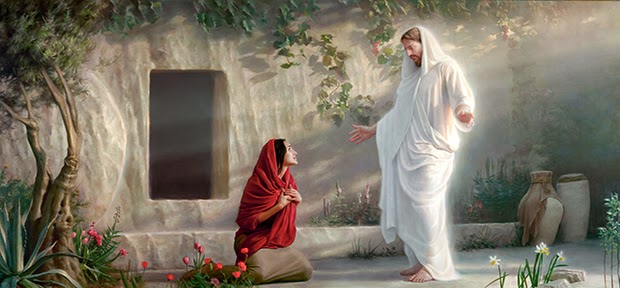

Easter in my family was always one of the most important weekends of the year. We would go to Ferron for an extended family reunion. Our weekend consisted of playing Rook, eating food, golfing, spending the day out in the San Rafael Swell, hunting for Easter baskets, laughing with each other, and then attending sacrament meeting on Sunday. Our Sunday worship was a fairly choir number, a testimony of the Resurrection, and then home for a final family dinner before we went back to Vernal. I loved Easter so much, and I am so grateful for all of those memories.
Looking back, the spiritual aspect of the week leading up to our Easter celebration was largely nonexistent. I don’t remember discussing or thinking about Lent, Holy Week, Good Friday, or anything leading up to Easter weekend, other than the anticipation of our trip to Ferron. This didn’t have anything to do with my family, as Holy Week was nonexistent in LDS culture. Whether to avoid feeling “too Catholic” or something else, we just never really talked about Holy Week, and maybe even felt like we shouldn’t.
I think that has started to change, and I believe it is one of the most significant quiet shifts in our worship culture in recent memory. The Church has begun encouraging members to observe Holy Week — to walk through Palm Sunday, the Last Supper, Gethsemane, the Crucifixion, and the long silence of Holy Saturday before arriving at Easter morning. The “Come, Follow Me” curriculum has increasingly focused attention on the Passion narrative in its full sequential weight. General leaders have spoken more openly about the value of sitting with the Savior’s suffering, not just celebrating its resolution.
This matters more than it might seem. There is a reason that Christians across almost every tradition have observed Holy Week for nearly two millennia. It shouldn’t just be a liturgical habit or religious formalism. It should help us engage with the journey to Easter Sunday, which is itself part of the gospel. The Resurrection means something different — something far more visceral and hope-filled — when you have walked through the grief that precedes it. “He is risen” means a lot more when we have mentally engaged with the sense of loss that came from Good Friday and Holy Saturday, when all the disciples believed that everything was finished and lost.
What follows is an invitation to do something I have found personally transformative: to spend each day of Holy Week with one passage of scripture and one small devotional practice. Not a reading list. Not a checklist. Just a daily moment to slow down and let the events of that last week sink a little deeper into your soul.
These are not long asks. Each one takes only a few minutes. But I believe that if you give Holy Week even a fraction of the attention it deserves, you will arrive at Easter Sunday differently than you otherwise would. And I believe that difference is worth something — for you, and for the people around you who watch the way you live your faith.
Palm Sunday — The Arrival of a Different Kind of King
“Rejoice greatly, O daughter of Zion; shout, O daughter of Jerusalem: behold, thy King cometh unto thee: he is just, and having salvation; lowly, and riding upon an ass, and upon a colt the foal of an ass.” — Zechariah 9:9 (KJV)
The crowds who lined the road into Jerusalem were expecting a conqueror — a king who would ride in on a warhorse, overthrow Rome, and restore Israel’s national glory. What they got was a man on a borrowed donkey, fulfilling a prophecy most of them probably didn’t recognize in the moment. Jesus never conducted His ministry as the audience expected. He consistently subverted the categories people had prepared for Him.
Today, take a few minutes to sit with this question: Where in your own life are you expecting God to show up in a way He has never promised to show up? What would it look like to let go of the conquering king you’ve been waiting for, and receive the one who actually came?
This is also a day to practice genuine welcome. Is there someone in your life — a family member or a friend — who needs to feel welcomed today? Write them a text or a note. Let today be a day of welcome for the week ahead.
Monday of Holy Week — The Temple Cleansed
“And Jesus went into the temple of God, and cast out all them that sold and bought in the temple, and overthrew the tables of the moneychangers, and the seats of them that sold doves, and said unto them, It is written, My house shall be called the house of prayer; but ye have made it a den of thieves.” — Matthew 21:12–13 (KJV)
This is the most physically forceful act in the recorded ministry of Jesus, and it is worth sitting with how surprising that is. The Son of God — who would soon submit silently to arrest, mock trial, and execution — chose this moment to act with what we can only call righteous anger. He was not detached or serene. He was moved. Something mattered enough to Him to overturn tables.
What this passage is really about is the difference between the outward forms of religion and its inward reality. The moneychangers weren’t doing anything technically illegal — they were providing a service. But they had turned a house of prayer into something else entirely. The spirit had been crowded out by the machinery.
Today’s practice is one of honest examination. What in your own spiritual life has become more about form than substance? Not self-condemnation — just honest noticing. Pick one practice you have been going through the motions on, and today, do it like you mean it.
Tuesday of Holy Week — Teaching in the Temple
“Jesus said unto him, Thou shalt love the Lord thy God with all thy heart, and with all thy soul, and with all thy mind. This is the first and great commandment. And the second is like unto it, Thou shalt love thy neighbour as thyself. On these two commandments hang all the law and the prophets.” — Matthew 22:37–40 (KJV)
Tuesday of Holy Week was arguably the most intellectually intense day of Jesus’s ministry. He was challenged publicly by the Pharisees, the Sadducees, and the scribes — each group trying to trap Him in a contradiction, a heresy, or a political mistake. He answered every challenge with a clarity that silenced His opponents. And when one of them finally asked the disarming question — “Which is the great commandment?” — He gave an answer so simple and so complete that it has anchored Christian theology ever since.
Everything hangs on love. Not as a sentiment, but as a practice. Love for God that is whole-hearted, full-souled, fully engaged. And love for the people around us that is as honest and generous as the love we instinctively offer ourselves.
Today’s practice is relational. Think of someone you have been giving partial attention to — a child, a spouse, a parent, a friend. Today, give them the real thing. Put down what you are doing when they speak. Ask a question about their life and actually listen to the answer. Let today be a day of full presence.
Wednesday of Holy Week — The Silence Before the Storm
“She hath done what she could: she is come aforehand to anoint my body to the burying. Verily I say unto you, Wheresoever this gospel shall be preached throughout the whole world, this also that she hath done shall be spoken of for a memorial of her.” — Mark 14:8–9 (KJV)
Wednesday of Holy Week is sometimes called “Silent Wednesday” because the Gospels record no public activity. But in the days just before, a woman — traditionally identified as Mary of Bethany — anointed Jesus with an expensive perfume. His disciples were indignant at what they called waste. Jesus defended her completely. What others saw as extravagance, He recognized as love.
There is something quietly important in the fact that in the final days before the cross, what Jesus chose to highlight was not a sermon, not a miracle, but a simple act of devoted, costly attention from someone who understood, better than almost anyone, who was sitting in front of her.
Today’s practice is gratitude expressed out loud. Think of someone whose influence on your faith, your character, or your life has never been fully acknowledged by you. Write them a letter, send a voice message, or make a call. Don’t let another week go by with that gratitude unspoken.
Holy Thursday (Maundy Thursday) — The Last Supper and the Garden
“For I have given you an example, that ye should do as I have done to you. Verily, verily, I say unto you, The servant is not greater than his lord; neither he that is sent greater than he that sent him.” — John 13:15–16 (KJV)
“And he went a little further, and fell on his face, and prayed, saying, O my Father, if it be possible, let this cup pass from me: nevertheless not as I will, but as thou wilt.” — Matthew 26:39 (KJV)
This is the most layered day of Holy Week. At the Last Supper, Jesus washed His disciples’ feet — the task of the lowest household servant — and then explained that this was the shape of His kingdom. Not rank and authority, but basin and towel. Greatness, in His definition, looks like getting on your knees in front of someone else and serving them.
Then Gethsemane. And if Palm Sunday shows us a king who arrived differently than expected, Gethsemane shows us a Savior who suffered more fully than we usually allow ourselves to imagine. He was “exceedingly sorrowful, even unto death.” He begged His friends to stay awake with Him. He asked His Father if there was another way. He was afraid and lonely in ways that ought to shatter any picture of detached, effortless divinity.
And yet: not my will, but Thine.
Today has two practices. The first is an act of humble service — something concrete and physical that you do for someone else without being asked and without drawing attention to it. The second is a prayer of surrender. Whatever you are holding tightly right now — a fear, a plan, a grief, an outcome you desperately want — bring it to God tonight and practice the words: not my will, but Thine.
Good Friday — The Cross
“When Jesus therefore had received the vinegar, he said, It is finished: and he bowed his head, and gave up the ghost.” — John 19:30 (KJV)
“It is finished” — tetelestai in the Greek — is one of the most loaded phrases in all of scripture. In the ancient world, the word was stamped on financial documents when a debt had been paid in full. Nothing more owed. Account settled. The suffering was not a defeat. It was a completion.
Good Friday is the hardest day of the Christian year to sit with, and I think that difficulty is exactly the point. We are not meant to rush past the cross to get to the empty tomb. The Resurrection is only as powerful as the death that precedes it. And the death was real — not symbolic, not theatrical, but fully, humanly real.
Today’s practice is a specific act of release. Is there something you have been carrying — guilt over a past mistake, shame about who you have been, a sin you have confessed but not yet let go of? Today is the day to set it down. Not because it didn’t matter, but because the cross is precisely for this. Write it down on a piece of paper. Pray over it. Then destroy the paper. Let this be the day you actually believe that it is finished.
Holy Saturday — He Descended Below All Things
“And there were gathered together in one place an innumerable company of the spirits of the just, who had been faithful in the testimony of Jesus while they lived in mortality… All these had departed the mortal life, firm in the hope of a glorious resurrection, through the grace of God the Father and his Only Begotten Son, Jesus Christ. I beheld that they were filled with joy and gladness, and were rejoicing together because the day of their deliverance was at hand.” — Doctrine and Covenants 138:12–15
While the disciples above ground were sitting in grief and silence, not knowing what had happened or what would come next, something extraordinary was unfolding that they could not see. Latter-day Saint theology holds that the period between the Crucifixion and the Resurrection was not a time of silence at all — it was one of the most expansive moments in the history of the gospel. In the vision recorded in Doctrine and Covenants 138, Joseph F. Smith saw Christ entering the world of spirits and organizing a mission to those who had died without a full knowledge of the gospel. Every person who ever lived, across every age and nation, was to be given the opportunity to receive what they had not received in mortality. The reach of the Atonement was not bounded by time or geography or the accident of when and where someone was born. No one would be left out.
This is one of the most quietly radical doctrines in all of scripture. The conventional picture of Holy Saturday is one of absence — a sealed tomb, a grieving handful of disciples, a God who has gone silent. But the Restoration gives us a different picture entirely. While the world mourned, Christ was working. While the disciples sat in the dark, He was carrying the light into a deeper darkness than any of them could have imagined, descending below all things so that He might fill all things. The silence was not emptiness. It was the sound of the most thorough rescue operation ever undertaken.
Today’s practice is to think of someone in your life, living or dead, for whom the reach of Christ’s grace feels uncertain — someone who never had the gospel, someone who struggled with faith, someone you’ve worried about. Let Holy Saturday be the day you sit with the confidence that the Atonement is bigger than our categories, longer than our lifetimes, and deeper than our fears.
Easter Sunday — He Is Risen
“He is not here: for he is risen... ” — Matthew 28:6 (KJV)
Everything that came before this moment — every act of trust, every dark night, every question without an answer, every moment of grief and silence — finds its resolution here. He is risen.
Those four words are the foundation beneath every other foundation. They are the reason the disciples who scattered in fear became people willing to die for what they had seen. They are the reason that death, while still real and still painful, does not get the final word. They are the reason that reunion is not a comforting metaphor but an actual promise.
The challenge for today is to share your testimony, even if it is a hopeful belief, in the resurrection of Jesus Christ.
I have had a dozen undeniable experiences in my life that confirm Jesus Christ is, in fact, our resurrected Lord. Some are so personal I’m not sure how I could share them, others I have shared in previous Easter posts. What I am most grateful for is the hundreds of micro-experiences, inspirations, serendipitous encounters, and tender mercies that have confirmed that God loves me and loves each person. The times when I have had one of those moments that have led me to help someone I had no idea needed it, or to say something someone needed to hear, have left such a deep impression on my soul. Sometimes all we need is to give a little more space in our hearts and minds for Jesus to be with us. That is the point of Holy Week.
To conclude my testimony, I believe that if we do small things this week, we will have loving moments of connection with God and our loved ones. I believe that Jesus will walk with us, and I know that all this effort and suffering we go through during this life will be rewarded with incomprehensible joy in the eternities because of Christ’s atonement, and I am so thankful to believe that He is risen.
ADDITIONAL RESOURCES
Podcasts
- Faith Matters Podcast: Encouraging faithful inquiry amid complexity.
- Comeback Podcast: Sharing Stories of those who left the church and came back.
- Unshaken with Jared Halverson: In-depth historical and doctrinal studies for those wrestling with tough questions.
- Leading Saints: Insights into modern leadership and discipleship, often addressing nuanced challenges.
Books
- Saints: The Story of the Church of Jesus Christ in the Latter Days (Vols. 1–2): Thorough Church history, incorporating modern research.
- Planted by Patrick Q. Mason: A compassionate approach to faith challenges.
- The Crucible of Doubt by Terryl and Fiona Givens: Thoughtful exploration of faith reconstruction.
- Joseph Smith: Rough Stone Rolling by Richard Lyman Bushman: A deeply researched biography reflecting Joseph’s certainty and complexity.
- Making Sense of the Doctrine and Covenants by Steven C. Harper: A summary of the history and context for each section of the Doctrine and Covenants.
Blogs and Articles
- Gospel Essays: Accessible discussions suited for individual and group study.
- Faith Matters: Engages contemporary faith topics with candor.

 Gospel Essays