When I was about 25 and living in Las Vegas, I hadn’t really been going to church much, and I was feeling further from God than I’d ever been. I was dealing with my own faith crisis before they were a social media fad, and I was carrying a lot of guilt for many of my actions after my mission. So, when I got a phone call from the Stake Executive Secretary asking if I could attend a meeting with the Stake President, I was mostly worried I would get in trouble for something.
Instead, the Stake President, after asking about my past, in which I basically confessed the current state of my faith, asked me to serve as the Elders Quorum President in my new singles ward. A Bishop I’d never met, from the ward I had never attended, had submitted my name.
I was not prepared for that and asked him if he was sure that was a good idea. He explained to me that he and the Bishop both felt it was undeniable that God wanted me to serve in that calling. In that moment, I broke down and started crying. Even though I did not feel worthy, I felt, for the first time in years, that God loved me and, more importantly, trusted me. It was overwhelming.
That moment cracked something open in me. I started reading and studying the scriptures again, and eventually I picked up the current Priesthood lesson manual on the Life of Wilford Woodruff.
In one section, President Woodruff wrote about the importance of keeping records and writing in journals. The manual talked about how the miracles of his early life became faith-promoting experiences — not just for him, but for thousands of people who read about them after he was gone. That hit me hard. Not because of what President Woodruff wrote, but because I realized that I hadn’t really ever seen a journal from my ancestors, and I didn’t know that much about some of them.
I was blessed to know my grandparents and even most of my great-grandparents for many years, but I had not seen many journal entries from any of them, their parents, or grandparents. Hardly a record of what they believed, what they wrestled with, where they found God — or where they lost Him.
They were complex, generous, stubborn, and tender people who shaped me in ways I’m still discovering. But when it comes to their inner lives — their faith, their doubts, their quiet moments with God — I have almost nothing. And I wish I did. Not because my experience with them wasn’t meaningful to me, but because it was so meaningful, and now that meaning lives only in the fading memories of those of us who knew them.
My children will never know their great-grandparents the way I wish they could. The foundation they laid for our family is real, but much of it is invisible — unwritten, unrecorded, and slowly disappearing.
That absence haunted me when I read Woodruff’s words, and it led me back to my own missionary journals, which I hadn’t opened in years. I was overwhelmed with what I read. The spiritual experiences I’d had, the people I’d loved, the lessons I’d learned — I’d somehow forgotten most of them. Reading those entries didn’t just remind me of who I’d been. It reminded me of who God had been to me. I received a clear impression that I should compile my own personal history and start writing about my relationship with God again. Not just for myself but for my future wife, our future children, and generations to come.
That was 2005. I’ve been writing ever since.
I share all of this to set the stage for some thoughts on the Three Patriarchs (Abraham, Isaac, and Jacob) and how their stories have become the foundation for generations of people around the world — the kind of foundation one generation lays so the next has something to build on.
As a reminder, these patriarchal narratives are oral traditions. They were told and retold around fires and in tents for centuries before anyone scratched them onto a scroll. The people who shaped these stories weren’t writing biographies. They were building identity. They were answering the question every generation asks: Who are we, and why does God care about us?
John H. Walton, the Old Testament scholar whose Lost World series has shaped how I read Genesis, emphasizes that these ancient texts were always about function and purpose — not just recording what happened, but revealing what it meant. When he writes about Genesis, he argues that the narrative is fundamentally about establishing a covenant relationship with God as the foundation for the people called Israel.
So, as we think about Abraham, Isaac, and Jacob, my goal is for us to see patterns in their relationship with God so we can hopefully find some insight that helps us connect with God in new ways.
Abraham: Three Pillars of Trust
The story of Abraham doesn’t start with confidence. It starts with a call to leave everything familiar — family, homeland, the gods his father worshipped — and walk into uncertainty with nothing but a promise. God told him his descendants would be as numerous as the stars, and Abraham believed it, even though he and Sarah were old and childless and the math didn’t work.
But what makes Abraham’s story so theologically significant is not a single moment of faith. It is a pattern of trust that plays out throughout his life and shows up most clearly in three episodes that scholars repeatedly cite as pillars of his covenant relationship with God.
The Journey to Egypt — Trust in God’s Protection
When famine drove Abraham and Sarah to Egypt, Abraham made an infamous decision: he asked Sarah to pose as his sister, fearing the Egyptians would kill him to take her. The narrative within the scriptures sort of frames this as a mistake by Abraham, maybe even a lack of trust in God, but what the broader narrative reveals is an important insight into the nature of trust in a covenant relationship.
The covenant promise — land, descendants, blessing — was nowhere to be seen, and Abraham was navigating a world that had given him no concrete reason to believe it would be found. And yet, even when he stumbled, the covenant held. God protected Sarah and returned her to Abraham. The promise was preserved not because Abraham was perfect, but because God was faithful.
This is one of the foundational patterns in the patriarchal narratives: the covenant does not depend on perfection on our part. It depends on the faithfulness of God, and on our continued willingness to trust — even imperfectly — that God is present and active in our unfolding story.
The Division with Lot — Trust Expressed Through Generosity
When conflict broke out between the herdsmen of Abraham and his nephew Lot, Abraham made a striking choice in giving Lot the first pick of all the land. “If you go left, I will go right; if you go right, I will go left” (Genesis 13:9). Lot chose the well-watered plains of Jordan, the obviously better land and Abraham took what was left.
John Walton emphasizes that in the ancient Near East, land was not simply property — it was identity, security, and divine inheritance. For Abraham to yield that choice so freely was not just an act of generosity. It was an act of radical theological trust. He was saying, in effect: I do not need to grasp at what seems most secure, because the God who made the covenant will provide.
Immediately after Lot departs, God speaks to Abraham and reaffirms the covenant: look in every direction, because all of it will be yours and your descendants’ forever (Genesis 13:14–17). This is a critical moment that teaches us something about generosity as part of our covenant relationship with God. It is teaching us that generous, open-handed living is a form of covenant faithfulness. Abraham’s willingness to relinquish control of the resources God had given him to someone else became an occasion for God to reassert the covenant promises.
The Binding of Isaac — Trust That God Delivers
The binding of Isaac in Genesis 22 is the climax of Abraham’s spiritual journey and one of the most studied passages in all of scripture. God commands Abraham to sacrifice his son — the very son through whom the covenant promise was to be fulfilled. It is critical to recognize the story’s deliberate brutality. The fact that no one who has heard or read this story for millennia can comprehend Abraham’s or God’s actions in it is the narrative’s actual purpose.
Abraham’s trust was not blind resignation. It was a conviction — earned through decades of walking with this God — that the God who had preserved the covenant through famine, conflict, and barrenness would not ultimately destroy it now. Abraham acts, irrationally loyal to God in our eyes, but of course, God delivers an answer with the ram in the thicket. Abraham gives the place a name — Jehovah-jireh, “the Lord will provide” — as a summation: a lifetime of faith through ups and downs will always reveal that God does truly provide.
Isaac: The Holiness of Quiet Faithfulness
Isaac is the least dramatic patriarch, with the fewest verses dedicated to his life. He doesn’t have Abraham’s epic journeys or Jacob’s wrestling match. He mostly stays put, re-digs the wells his father dug, makes peace with hostile neighbors, and passes the blessing to the next generation. Scholars call him a transitional figure, and they mean it mostly as a neutral observation. But I want to push back gently on the assumption buried in that framing — the idea that “transitional” is somehow lesser.
Not every faith has to be dramatic. Not every life of covenant faithfulness has to be defined by crisis, exile, or divine confrontation. And more importantly — this might be the most important thing I want to say about Isaac — the steady, consistent, undramatic faith of one generation is not merely adequate. It is its own extraordinary gift to everyone who comes after.
Isaac re-digs the wells Abraham dug. When the Philistines filled them in out of spite, he didn’t leave or escalate or abandon the land. He dug them again. And again. He named them differently — Esek, Sitnah, Rehoboth, Beersheba — and he kept going (Genesis 26:18–25). The theological point embedded in this very undramatic episode is not subtle: the work of maintaining access to living water is holy. It doesn’t make for a compelling story around the fire, but a generation that doesn’t dig those wells dies of thirst.
Covenant living is not measured solely by miraculous founding moments. It is also measured in the generations that sustain what was founded. Isaac’s role is not peripheral to the covenant story — it is the covenant story in one of its most essential expressions: the faithful carrier who keeps the channel open so that what was given can be received by whoever comes next.
There is something profoundly countercultural in taking Isaac seriously on his own terms. We live in a world that glorifies the founder, the visionary, the person whose faith was tested in fire and emerged transformed. We write books about Abraham and Jacob. Isaac barely gets a chapter. But the truth is that most generations are Isaac generations. Most people who live lives of genuine covenant faithfulness don’t do it through spiritual drama. They do it by showing up. By maintaining the practices. By raising their children in the covenant. By being the person whose faith, when you look back on it, was simply always there — steady, warm, and unfailing.
That is not a diminished form of a covenant relationship with God. It is, in many ways, the most sustainable and generative form. Because a faith that only functions under pressure is fragile. A faith that is quiet and consistent and deeply rooted — the kind of faith that doesn’t require a crisis to activate it — is the kind of faith that can actually be passed on. It is the kind of faith that children absorb without even knowing they are absorbing it, because it is simply the texture of the home they grew up in.
Without Isaac, there is no Israel. That is not a small thing. The covenant doesn’t travel only through the dramatic and the tested. It travels through the faithful and the present. And that is exactly the kind of covenant relationship God honors.
Jacob: Wrestling Until You Are Blessed
Jacob is where the story gets messy.
Jacob is not a hero in any conventional sense. He was born grabbing his brother’s heel — and that image turns out to be prophetic. He manipulates Esau into selling his birthright for a bowl of stew. He deceives his aging, nearly blind father, Isaac, to steal Esau’s blessing. When Esau’s fury becomes dangerous, he runs. He spends years in exile working for his uncle Laban, only to be deceived in return, working fourteen years for a wife he was promised after seven. He accumulates flocks and family through a combination of cunning and hard labor, and still, he cannot outrun the conflict inside himself.
The text does not ask us to excuse any of this. It presents Jacob’s character honestly and lets the narrative do its work. And the work the narrative is doing is this: showing us what it looks like when a deeply flawed person refuses to let go of God.
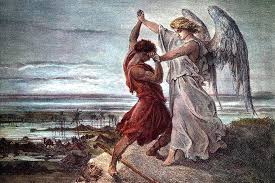
That refusal reaches its climax at the ford of the Jabbok. The night before Jacob is to face Esau — the brother he wronged, approaching now with four hundred men — Jacob finds himself alone. And then someone is wrestling with him until the breaking of the day (Genesis 32:24).
The text is deliberately ambiguous about the figure’s identity. An angel. God Himself. Jacob’s own fear externalized. This is not just a physical encounter. It is the reckoning Jacob has been postponing for his entire life — with God, with himself, with the gap between the man he has been and the man the covenant requires him to become.
During the wrestle, Jacob’s hip is wrenched out of its socket. He is losing. And he will not let go.
“I will not let you go unless you bless me.” (Genesis 32:26)
That single line is one of the most theologically loaded statements in all of scripture. Jacob does not ask to be released from the struggle. He does not ask for the pain to stop. He asks for the blessing — and he asks for it from the very One who is the source of his anguish. That is not the behavior of someone who has abandoned faith. That is the behavior of someone who has decided, in the hardest possible moment, that they will not quit their covenant relationship with God, even when that relationship is one of the sources of their pain.
And the blessing comes. But it comes with a new name: Israel. One who wrestles with God. The covenant people are not named for their obedience or their clarity or their certainty. They are named for their wrestling. The storytellers who shaped this narrative understood something essential: the faith that earns its name is not the faith that was never tested. It is the faith that refused to release its grip even when it was losing.
Jacob limps away from the Jabbok. He is permanently marked. But he walks toward his brother.
That detail matters enormously. Because if the wrestling match is where Jacob’s covenant relationship with God is forged, the reconciliation with Esau is where it is demonstrated. He has spent his entire life avoiding the consequences of who he has been. Now he walks toward them. When he sees Esau approaching with four hundred men, he bows to the ground seven times. He calls his brother “my lord” and himself “your servant.” He offers gifts not as bribery but as a genuine acknowledgment of the wrong he did.
And Esau runs to him and embraces him.
Reconciliation in the ancient Near Eastern world was not merely a personal or emotional event — it was a covenant act. The restoration of a broken relationship was itself understood as a kind of covenant renewal. Jacob’s willingness to return to Esau, to expose himself to the consequences of his past, to ask for restoration rather than run from it — that is the outward expression of the inward transformation the wrestling match began.
He wrestled with God and would not quit. Then he walked toward his brother and would not hide. Both are acts of covenant faithfulness. Together, they are what made him Israel.
The Twelve Tribes: Why Community Identity Matters
The stories of the Patriarchs do not end with Jacob’s wrestling match. It ends with his twelve sons who become twelve tribes — and that transition from individual patriarch to tribal community is one of the most important moves in all of scripture. The covenant was no longer carried by one person. It was distributed across a diverse community, each tribe with its own identity, its own gifts, its own role.
Judah would carry the royal line. Levi would carry the priestly function. Joseph — through Ephraim and Manasseh — would carry the birthright blessings. Benjamin, Zebulun, Naphtali, Dan, Gad, Asher, Issachar, Reuben, Simeon — each had a place, a purpose, a contribution that made the whole nation function. They were different from each other, sometimes dramatically so, but they were bound together by a shared covenant identity rooted in the foundations their fathers had laid.
This is not just an ancient organizational chart. It’s a theological statement about how God’s purposes are fulfilled: not through isolated individuals but through diverse communities who share a common foundation and purpose.
Modern research bears this out in striking ways. The Harvard Study of Adult Development, which tracked participants for over 80 years, reached a conclusion that would not have surprised the ancient Israelites: happiness is most strongly linked to the depth of our interpersonal connections — not to achievements, career success, or wealth. Psychologists David McMillan and David Chavis, in their foundational research on sense of community, identified four elements essential for human flourishing within groups: membership (a feeling of belonging), influence (a sense of mattering to the group), integration and fulfillment of needs (shared resources through membership), and shared emotional connection. Research published in the Journal of Happiness Studies found that group identification — a sense of belonging to a social group, coupled with a sense of commonality with its members — is a consistent predictor of life satisfaction, and that possessing multiple group identifications simultaneously further enhances well-being.
The twelve tribes embody all of this. Each tribe had membership — they knew who they were because they knew where they came from. Each had influence — their unique gifts shaped the direction of the whole. Each had shared resources—the covenant blessings were distributed throughout the community. And each had a deep emotional connection — bound by shared stories, shared rituals, and the shared memory of Abraham, Isaac, and Jacob.
I wrote about this idea in my earlier post on generational happiness — namely, that the church creates conditions for belonging, purpose, and agency that are difficult to replicate elsewhere. The twelve tribes are the original model for this. God didn’t design the covenant community to be a collection of identical people. He designed it to be a community of different people, united by a shared foundation, whose differences made the whole body stronger.
This matters for us today because one of the great struggles of modern life is the loss of this kind of rooted community identity. We have more options than any generation in history for finding “our people,” and yet studies consistently show that loneliness, depression, and disconnection are rising — particularly among younger generations. As one research review put it, belonging is “a fundamental human need that predicts numerous mental, physical, social, economic, and behavioral outcomes.” When that need goes unmet, the effects are devastating. When it is met — especially within communities that share purpose and history — the effects are transformative.
The patriarchs built the foundation. The twelve tribes built the community atop it. And the pattern is still available to us.
What Gets Passed Down
Here’s what I want my children to understand about these stories.
Abraham teaches us that covenant faith is built on trust — not on certainty. Trust expressed in generosity, trust that God protects what matters, and trust taken all the way to its most costly limit. His entire life is a demonstration that the covenant holds not because the human partner is perfect, but because the trust is real.
Isaac teaches us that quiet, consistent faithfulness is not a lesser form of covenant relationship. It may be the most generative form. He kept the wells open. He raised the next generation in the covenant. He was simply, steadily, always there. And that is exactly the kind of faith that can actually be passed on.
Jacob teaches us that God does not require us to be good before He enters into a covenant with us. He requires that we refuse to let go. The wrestling is the covenant. The limping walk toward your brother with your hands open — that is what Israel means.
Together, these three stories say the same thing in three different registers: faith is not a single decision. It is a generational project. It is handed down, wrestled with, carried forward, and sometimes nearly lost before someone picks it up again. The God who introduces Himself as “the God of Abraham, Isaac, and Jacob” is not just listing names. He is saying: I am the God who stays with families across generations, through trust and silence and struggle. I am the foundation beneath your foundations.
That’s why I write. Because I know that somewhere down the line, one of my kids or grandkids might be sitting alone in the dark, wrestling with something they can’t name, and they might need to read that someone in their family wrestled too. And stayed. And was blessed.
President Woodruff understood this. He once said:
I wish to say to my young friends that it will be a great blessing to them, and their children after them, if they will keep a daily journal of what takes place with them and around them. … ‘What shall I write?’ you ask. Write about anything that is worth preserving, or the best you have.
And in his own journal, he wrote the words that changed the course of my life:
We are not apt to think of the importance of events as they transpire with us, but we feel the importance of them afterwards. We are living in one of the most important generations that man ever lived on earth, and we should write an account of those important transactions which are taking place before our eyes.
He was right. Every generation is among the most important. And the ones who write it down — who lay down foundations for those who come after — give their children something to hold onto when the wrestling starts.
ADDITIONAL RESOURCES
Podcasts
- Faith Matters Podcast: Encouraging faithful inquiry amid complexity.
- Comeback Podcast: Sharing Stories of those who left the church and came back.
- Unshaken with Jared Halverson: In-depth historical and doctrinal studies for those wrestling with tough questions.
- Leading Saints: Insights into modern leadership and discipleship, often addressing nuanced challenges.
Books
- Saints: The Story of the Church of Jesus Christ in the Latter Days (Vols. 1–2): Thorough Church history, incorporating modern research.
- Planted by Patrick Q. Mason: A compassionate approach to faith challenges.
- The Crucible of Doubt by Terryl and Fiona Givens: Thoughtful exploration of faith reconstruction.
- Joseph Smith: Rough Stone Rolling by Richard Lyman Bushman: A deeply researched biography reflecting Joseph’s certainty and complexity.
- Making Sense of the Doctrine and Covenants by Steven C. Harper: A summary of the history and context for each section of the Doctrine and Covenants.
Blogs and Articles
- Gospel Essays: Accessible discussions suited for individual and group study.
- Faith Matters: Engages contemporary faith topics with candor.

 Gospel Essays