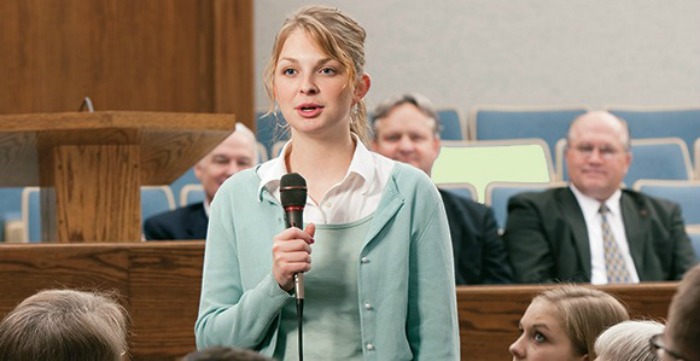
For the uninitiated, Latter-day Saints worldwide join in what we call the Fast and Testimony Meeting every first Sunday of the month. These meetings are a wild tradition where we let anyone who came to church come up to the pulpit and say whatever they want. I have heard some of the craziest and also some of the most sublime things in my life during these meetings.
I think there came a time, 15-20 years ago when the very predictable outcome of this kind of freedom produced a lot of comments that were making the meetings a bit of a punchline instead of the intended spiritual experiences the meetings were designed to represent. So, church leaders sought to create a framework for what should be the focus of comments during the meeting. They sought to more simply and clearly define what a “testimony” was and also emphasize the importance of having one.
We were all encouraged to distill our testimony into declarations of fact around key pillars of our faith: The truthfulness of the Book of Mormon, the atonement of Jesus Christ, Joseph Smith being the restoration prophet, the current prophet being inspired by God, etc. The thinking went like this – if we all engaged in this version of a testimony meeting, we could hear from more people, have spiritually focused words, and avoid some of the stuff that made the meeting messy. I think in some ways this initiative succeeded in its goals – I hear a lot of similar declarations from all different ages of people, and it feels like there is a bit more purpose behind the things I hear every month – even though I must admit I miss a lot of the crazy stuff I used to hear.
To bear testimony means to declare gospel truths as inspired by the Holy Ghost. Testimonies should be brief so that many people can participate.
Church Handbook 29.2.2
The focus on acquiring and sharing our testimony as the foundation of belief created a premise that factual knowledge was the preferred way to experience our relationship with God. This makes some sense in our secular society, where our learning and thinking brains are geared toward the scientific method of obtaining knowledge. It also fits in with how we often highlight the parts of the scriptures and our own personal experiences when God reveals himself definitively.
The traditional viewpoint that has followed this emphasis is that young people or members of the church believe the first step they should take in their faith journey is to obtain a testimony – in this context, this means an experience or manifestation that gives us knowledge of gospel truths. The logical conclusion then is that we should spend our time on things that would produce that knowledge – reading the scriptures, praying for answers, attending church meetings, and things related to obtaining knowledge. These are all very good and worthy things to spend our time on, and the expected experiences often do come, even if not on the timelines often hoped for.
The downside to this approach in our relationship with God is that it sets up a transactional relationship with God – where we believe if we put in a certain amount of effort, He then produces results for us as a reward for our efforts. While that may work in some instances, many people put forth the effort, maybe even more effort than others, and they get no such reward, leaving them wondering if God is there or if they are not living worthy of the reward.
It is also difficult to find support in the scriptures for obtaining knowledge as the first step in our relationship with God. The scriptures emphasize having Faith to follow the words of Jesus Christ even with the absence of knowledge as the first principle of the gospel. We are promised that there will be blessings (many different forms of blessings) that come from acting in faith, yet, there are no guarantees that we will obtain knowledge; even Paul and Joseph Smith knew this, both explaining that having knowledge is a gift of the spirit that not all people would obtain (D&C 46, 1 Corinthians 12).
Faith Leads to a Different Kind of Knowledge
In Alma Chapter 32 in the Book of Mormon, the principle of Faith is taught in a metaphor about a seed (the words of Jesus Christ), if nourished (Faithful actions), will grow to produce good fruit. The metaphor teaches us an important thing about what kind of knowledge faith leads us to:
- We received the Seed – We hear or learn about Jesus Christ and the gospel and desire to believe
- We plant the seed in our hearts – We embark on an experience to live and follow the gospel
- We feel that the seed is good – We evaluate whether living the gospel is good based on how we feel, what we experience, and what we are inspired to learn. If it is good, then we have received knowledge, but not certainty about facts, instead knowledge that the gospel is good
- We nourish the good seed to produce good fruit – If we continue taking action in faith, nourishing our faith by learning, praying, and living the gospel then eventually our faith will produce fruit that confirms that the life we lived was also good
Knowing something is good is the first step that God uses to communicate with us. This is also true for knowing something is wrong – we feel bad, guilty, or empty. Simply knowing something is good is a difficult concept to translate to others, and many people use good feelings to justify behavior they know is not actually good for them.
This is why the metaphor does not stop once there is knowledge that the words of Christ are good. It continues with the suggestion to continue acting in faith and nourishing our faith until it produces good fruit in our lives. This kind of testing and faithful commitment takes time to show the evidence that the gospel is good, yet when that good fruit is produced it is not only convincing to ourselves but to all those around us. This kind of knowledge that the words of Christ are good is powerful. Jesus alluded to this ability for others to see that powerful evidence when He said, “Ye shall know them by their fruits.”
What is a Testament
Let’s look at a few definitions in Hebrew:
Testimony = a solemn declaration that the covenant has been fulfilled, is true, and witnessed
Testament = a covenant or sacred agreement
Arguably, the most valuable things believers in Jesus Christ have in their possession are the three Testaments of Jesus Christ: The Old Testament, the New Testament, and the Book of Mormon: Another Testament of Jesus Christ. These sacred collections of experiences are the foundation of our faith. What makes them powerful is not the individual principles they teach or lists of guidance and wisdom – what makes them powerful is they are the experiences of real people, like us, and their experiences with God. They give us hope because we are real people, struggling like them, and relying on God to help us. Their lives show that by living by faith, God’s promises are fulfilled in many different ways and at different times. Their lives are a testament that God is real, that He does love us, and that He will bless our lives.
So before a testimony must come a testament. The testimony is the witness that the testament is fulfilled. In the framework of the seed metaphor – when our life produces good fruit – that is a testament. When we share those experiences with others and declare our witness – that is a testimony.
In contrast to the institutions of the world, which teach us to know something, the gospel of Jesus Christ challenges us to become something.
Dallin H. Oaks
The greatest strength of the Restored Gospel of Jesus Christ is not in its exclusive set of facts but in its ability to produce a large collection of great people over generations. The lives of these people – not what they know – are a testament that God is real and that he is engaged in our lives and seeking to bring goodness into the world.
There was a man on my mission named Tom Sheppard. He was the most gentle and wonderful man. He had a beautiful voice that he shared in the ward choir and as a solo singer in several sacrament meetings. He had been widowed for years and he often shared how much he loved and missed his wife. I was fortunate to get to know Tom and feel of his spiritual witness of Jesus Christ.
Toward the end of my mission, Tom had a stroke and could no longer speak very well, but worst of all he couldn’t sing. This was devastating to him. We would still spend time with him, but his illness got worse and eventually, he was hospitalized. About a week before my mission ended, I was asked to come to the hospital to give Tom a blessing. I had to get special permission to leave the mission to go to the hospital he was in and was met with many members of his family who had come to see him. Everyone knew the time was drawing near for Tom to pass on to see his wife in heaven. I was definitely feeling beneath the moment and had fasted for the Lord to help me with the blessing.
When I laid my hands on Tom’s head I was completely overwhelmed with love for him and his family. I saw in my mind’s eye the powerful impact Tom had on his family and so many other people when he was in the military, as he served in the church, as he raised his family, but most of all with his sweet wife who he always talked about. I saw them in my mind reunited and felt the most amount of love I think I have ever felt for a group of people. I knew Tom was going to die, but I knew that Tom had created at Testament of Jesus Christ. His life was good and everyone who knew him knew it was good.
Tom, through probably thousands of ups and downs, mistakes and successes, hardships, trials and amazing blessings had become like Jesus Christ. Not perfect, not known by billions of people, but like Jesus in that his influence made a difference in other’s lives and his life was full of joy because of it.
So here I am, a witness of that incredible man and that moment, and I am testifying of a covenant fulfilled and power and goodness that is true.
Right now, as many people struggle with faith, knowledge of truth, and many other things that create confusion, I fear we are missing the point of the gospel. The moving of mountains comes through living and taking faithful actions not in knowing and proving things to be true. It is only true if it produces good fruit.
So, what if we looked at our faith journey differently? What if our focus shifted to building a testament instead of a testimony? What if we looked at our lives as an opportunity to radiate goodness and light to everyone around us and use our faith – not knowledge – to interpret our spiritual experiences in a way that was meant to build a lifelong testament in Jesus Christ.
Words do have power, and there have been times when sharing or hearing someone’s testimony has impacted me deeply. This is not meant to diminish the value of testimony, it is critical to the Lord’s mission and is the point of discipleship to spread the word to others and to be a witness of the covenants of God. What I am saying, is that if our focus is on building a testament first, then our testimony will come naturally and it will be more impactful because the fruits of our lives will show, not only say, that God is with us.
In the past four weeks of study material for the Doctrine and Covenants (Sections 18-28), there are three things that hit me hard that relate to the idea of Testaments.
- “The worth of souls is great in the sight of God” and “[if you] bring, save it be one soul unto me, how great shall be your joy” – Section 18
- The Atonement caused even Jesus Christ to tremble because of pain, but he completed the atonement so we could all change and learn and grow – Section 19
- On April 6, 1830, the church was formed and organized to bring the words of Jesus Christ to the world through a small group of disciples that would grow over time into millions of people bringing good fruit into the world – Section 20
These three sections are incredible because they show this pattern. Before the church was formed the message was clear – the goal is to bring people to Jesus Christ – He atoned for everyone and loves us all. The church’s purpose is to fulfill that mission and these early members of the church, despite all of the difficulty, mistakes, and persecutions they would face built a testament to Jesus Christ and that He fulfills his covenants.
I hope the simple idea of taking faithful actions to do good in this world resonates with you. I am a witness to God’s covenants being fulfilled when we try to do good in this world. I have been influenced by so many good people and it is impossible to show my gratitude enough for them. I do believe that if we focus on doing good, acting in faith, and building a testament then we will acquire a testimony that is more than just knowledge of facts, but knowledge that God really does care and really does influence people for good and he does it most often through a person willing to do good even when they don’t know everything.
ADDITIONAL RESOURCES
Podcasts
- Faith Matters Podcast: Encouraging faithful inquiry amid complexity.
- Unshaken with Jared Halverson: In-depth historical and doctrinal studies for those wrestling with tough questions.
- Leading Saints: Insights into modern leadership and discipleship, often addressing nuanced challenges.
Books
- Saints: The Story of the Church of Jesus Christ in the Latter Days (Vols. 1–2): Thorough Church history, incorporating modern research.
- Planted by Patrick Q. Mason: A compassionate approach to faith challenges.
- The Crucible of Doubt by Terryl and Fiona Givens: Thoughtful exploration of faith reconstruction.
- Joseph Smith: Rough Stone Rolling by Richard Lyman Bushman: A deeply researched biography reflecting Joseph’s certainty and complexity.
- Making Sense of the Doctrine and Covenants by Steven C. Harper: A summary of the history and context for each section of the Doctrine and Covenants.
Blogs and Articles
- Faith Matters: Engages contemporary faith topics with candor.
- Gospel Essays: Accessible discussions suited for individual and group study.

 Gospel Essays